[
Photo by Yllavm on Flickr:
Apsara Sculpture]
In my previous post about
Cambodian art, I have already mentioned the 2 points,
Khmer Dance and Khmer music, that show the world how the Cambodia's art it is that makes the country to be known as a country rich of culture. In addition to the previous two points, today, please find out more about the Cambodian art with one more important point below:
3. Khmer Visual Arts: The history of visual arts in Cambodia stretches back centuries to ancient crafts. Traditional Cambodian arts and crafts include textiles, non-textile weaving, silversmithing, stone carving, lacquerware, ceramics, wat murals, and kite-making.
Khmer Visual Arts can be divided into two types: - Khmer traditional visual art and
- Modern and contemporary visual arts
a.Traditional visual art: is a kind of visual art including Textiles, Non-textile weaving, Stone carving, Lacquerware, Silversmithing, Ceramics, Temple murals, Masks, Kites...
Textiles (Silk Weaving) 
[
Photo by Wikipedia: Cambodian woman weaving silk near Siem Reap]

[
Photo by christopherlevy on Flickr:
Khmer Textile]
Silk weaving in Cambodia has a long history. The practice dates to as early as the first century, and textiles were used in trade during Angkorian times. Even modern textile production evidences these historic antecedents: motifs found on silk today often echo clothing details on ancient stone sculptures.
Cambodia's modern silk-weaving centers are Takeo, Battambang, Beanteay Meanchey, Siem Reap and Kampot provinces. Silk-weaving has seen a major revival recently, with production doubling over the past ten years. This has provided employment for many rural women. Cambodian silk is generally sold domestically, where it is used in sampot (wrap skirts), furnishings, and pidan (pictoral tapestries), but interest in international trade is increasing.
Cotton textiles have also played a significant role in Cambodian culture. Though today Cambodia imports most of its cotton, traditionally woven cotton remains popular. Rural women often weave homemade cotton fabric, which is used in garments and for household purposes. Krama, the traditional check scarves worn almost universally by Cambodians, are made of cotton.
Non-textile weaving
[
Photo by Oziahz: Basket Weaving]
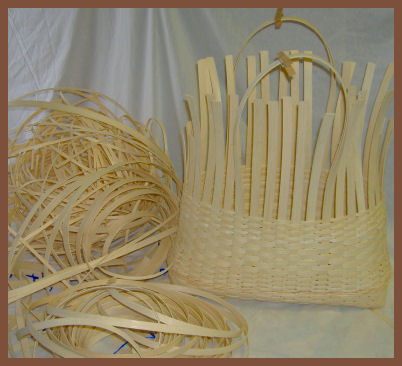
Many Cambodian farmers weave baskets (Khmer: tbanh kantrak) for household use or as a supplemental source of income. Most baskets are many of thinly cut bamboo. Regions known for basketry include Siem Reap and Kampong Cham. Mat weaving (tbanh kantuel) is a common seasonal occupation. They are most commonly made from reeds, either left a natural tan color or dyed in deep jewel tones. The region of Cambodia best-known for mat weaving is the Mekong floodplain, especially around Lvea Em district. Mats are commonly laid out for guests and are important building materials for homes. Wicker and rattan crafts (tbanh kanchoeu) made from dryandra trees are also significant. Common wicker and rattan products include walls, mats, furniture, and other household items.
Stone carving (Sculpture)
[
Photo by Felix_KL on Flickr: Apsara dancers carved in stone at Angkor Wat temple, Siem Reap, Cambodia. 2006]
Cambodia's best-known stone carving adorns the temples of Angkor, which are "renowned for the scale, richness and detail of their sculpture". In modern times, however, the art of stone carving became rare, largely because older sculptures survived undamaged for centuries (eliminating the need for replacements) and because of the use of cement molds for modern temple architecture. By the 1970s and 1980s, the craft of stone carving was nearly lost.
During the late 20th century, however, efforts to restore Angkor resulted in a new demand for skilled stone carvers to replace missing or damaged pieces, and a new tradition of stone carving is arising to meet this need. Most modern carving is traditional-style, but some carvers are experimenting with contemporary designs. Interest is also renewing for using stone carving in modern wats. Modern carvings are typically made from Banteay Meanchey sandstone, though stone from Pursat and Kompong Thom is also used.
Lacquerware
[
Photo by Wikipedia: A Cambodian woman works on a lacquered vase]
The height of Cambodian traditional lacquerware was between the 12th and 16th centuries; some examples of work from this era, including gilded Buddha images and betel boxes, have survived to the present day. Lacquerware was traditionally colored black using burnt wood, representing the underworld; red using mercury, representing the earth; and yellow using arsenic, representing the heavens. Lacquer on Angkorian stone dates to the 15th or 16 century.
In modern Cambodia, the art of lacquerwork nearly faded into oblivion: few lacquer trees survived, and lacquer was unavailable in local markets. Today's revival is still in its infancy, but 100 lacquer artists have been trained by a French expert under the guidance of Artisans d'Angkor, a company that produces traditional crafts in village workshops. Some artists are "beginning to experiment with different techniques and styles...to produce modern and striking effects."
Silversmithing
[
Photo by Wikipedia: Lotus-shaped Cambodian bowl (gold and silver alloy)]
Silversmithing in Cambodia dates back centuries. The Royal Palace traditionally patronized silversmiths' workshops, and silversmiths remain concentrated at Kompong Luong, near the former royal capital Oudong. Silver was made into a variety of items, including weaponry, coins, ceremonial objects used in funerary and religious rituals, and betel boxes. During Cambodia's colonial period, artisans at the School of Fine Art produced celebrated silverwork, and by the late 1930s there were more than 600 silversmiths. Today, silverwork is popular for boxes, jewellery, and souvenir items; these are often adorned with fruit, fire, and Angkor-inspired motifs. Men produce most of the forms for such work, but women often complete the intricate filigree.
Ceramics
[
Photo by kendrickhang on
Flickr:
Khmer Ceramics and Bronzes Revival Center, Siem Reap, Cambodia]
Cambodian pottery traditions date to 5000 BCE. Ceramics were mostly used for domestic purposes such as holding food and water. There is no evidence that Khmer ceramics were ever exported, though ceramics were imported from elsewhere in Asia beginning in the 10th century. Ceramics in the shape of birds, elephants, rabbits, and other animals were popular between the 11th and 13th centuries.
Potting traditionally was done either on a pottery wheel or using shaping tools such as paddles and anvils. Firing was done in clay kilns, which could reach temperatures of 1,000–1,200 °C, or in the open air, at temperatures of around 700 °C. Primarily green and brown glazes were used. In rural Cambodia, traditional pottery methods remained. Many pieces are hand-turned and fired on an open fire without glaze. The country's major center for pottery is Kompong Chhnang Province. In modern Cambodia, the art of glazed ceramics faded into oblivion: the technique of stoneware stop to be used around 14th century, at the end of Angkor era. Today this technique begin a slow revival through a Belgian ceramist who founded the Khmer Ceramics Revival Center, in Siem Reap, the organization lead vocational training and researches about this lost skill.
Wat murals (The murals in the temple) 
[
Photo by ultrapop design on Flickr: Wat mural]
Because of destruction during recent war, few historic wat murals remain in Cambodia. In the 1960s, art historians Guy and Jacqueline Nafilyan photographed 19th-century murals, providing a record of this lost cultural heritage. The best known surviving murals are at the Silver Pagoda in Phnom Penh, Wat Rajabo in Siem Reap province, and Wat Kompong Tralach Leu in Kompong Chhnang Province. In the last decade, wat murals have seen a resurgence, but Cambodia's surviving older murals are generally more refined and detailed.
Masks
[
Photo by nuke_ad on Flickr: Khmer Traditional Mask]
Masks are usually used by the artists for performing in Lakhaon Khaol in the Royal Palace in performances of the Reamker as early as the 13th century. Masks also used by Chhayam performers (Sva:Monky, Yeak:Giant...) to make fun in their performing.
See More at: http://www.culturalprofiles.net/cambodia/Directories/Cambodia_Cultural_Profile/-1831.html
Kites
[
Photo by Narith5 on Flickr: A boy with a kite]

[
Photo by Narith5 on Flickr:
A boy with a high flying kite]
Cambodia's kite-making and kite-flying tradition, which dates back many centuries, was revived in the early 1990s and is now extremely popular throughout the country. Kites (Khmer: khleng ek) are generally flown at night during the northeast monsoon season. A bow attached to the kites resonates in the wind, producing a musical sound. They usually see Khmer people (especially children) fly their kites after havesting.
b.Modern and contemporary visual arts
[
Photo by TaylorMiles on Flickr: Khmer painting, Overpriced painting, Angkor Wat]
Cambodia's tradition of modern (representational) drawing, painting, and sculpture was established in the late 1940s at the School of Cambodian Arts (later called the University of Fine Arts), where it occupied occupied much of the school's curriculum a decade later. These developments were supported by the government, which encouraged new areas of specialization (e.g. design and modern painting) at the school and purchased modern art for the Prime Minister's residences and for government buildings. Galleries opened in Phnom Penh during the 1960s, and cultural centers hosted exhibitions of modern paintings and provided art libraries. During the subsequent Khmer Rouge era, many artists were killed and art production nearly ceased.
After the fall of the Khmer Rouge, artists and professors returned the University of Fine Arts to rebuild arts training. Socialist Bloc governments sponsored the education of young art students in Poland, Bulgaria, the former Soviet Union, and Hungary during the late 1980s and early 1990s. Other local efforts aimed to re-establish workshops, collect documents, and preserve traditional knowledge.
Though several galleries present changing exhibitions in Phnom Penh, the vast majority of artists cannot support themselves through exhibitions and sales of modern work. Artists generally earn income from Angkor-inspired art for tourists or from painting commercial signs and large reproductions that in the West would be mechanically produced.
Several broad schools of art exist among modern Cambodian artists. Some artists, including Som Samai (a silversmith), An Sok (a mask-maker), and Chet Chan (a painter) follow colonial traditions to produce traditional Khmer art. Chhim Sothy's work is also derived from these traditions. Many young artists who studied abroad in the 1980s, including Phy Chan Than, Soeung Vannara, Long Sophea, and Prom Sam An, have presented a modern Khmer art forms combining subjects from Khmer art with Western modernism. Other notable Cambodian artists include Leang Seckon, Pich Sopheap, Svay Ken, Asasax, Chhan Dina, Lam Soeung, and Chhorn Bun Son. During the 1990s, Cambodia saw the return of many members of the Khmer diaspora, including several internationally recognized artists. Among these are Marine Ky and Chath Piersath.
These Khmer arts make Cambodia to be known as a country rich of culture......