Showing posts with label Cambodia Culture. Show all posts

Thursday, 14 June 2012

Welcome to Cambodia: Cambodian Culture: Royal Ballet of Cambodia Dance

Welcome to Cambodia: Cambodian Culture: Royal Ballet of Cambodia Dance

The Royal Ballet of Cambodia (Khmer: ល្ខោនព្រះរាជទ្រព្យ) is a form of performing arts established in the royal courts of Cambodia for the purpose of entertainment as well as ceremonial propitiation. It is the dominant genre of dance theatre in Cambodia that features the classical dance style (របាំក្បាច់បូរាណ) and is analogous to Thai dance theatre of the inner court, the lakhon nai.


Wikipedia: The Royal Ballet of Cambodia at curtain call (Paris, France 2010)


It is performed during public occasions and ceremonies in Cambodia as well as among Cambodians in other countries. Performances entails elaborately dressed dancers performing a slow and figurative set of gestures and poses meant to entrance the viewer. The repertoire includes dances of tribute or invocation and the enactment of traditional stories and epic poems such as the Ramayana. The music is played by an ensemble of xylophones, metallophones, woodwind instruments, drums, and gong chimes accompanied by a chorus.

Western names for this dance tradition often make reference to the royal court; including Cambodian court dance as it was performed and maintained by the attendants of the royal palaces. As a performing art, it is formally referred to as the Royal Ballet of Cambodia (and as Le ballet royal du Cambodge in French) by UNESCO, Cravath, Brandon, and others in the academic field; although this term may also refer to the royal ballet as a corps, the National Dance Company of Cambodia. The term "Khmer classical dance" is also used alongside "Royal Ballet of Cambodia" in the publications by UNESCO and mentioned authors.

In Khmer, it is formally known as Robam Preah Reach Trop (របាំព្រះរាជទ្រព្យ, lit. dances of royal wealth) or Lakhon Preah Reach Trop (ល្ខោនព្រះរាជទ្រព្យ, lit. theatre of royal wealth). It is also referred to as Lakhon Luong (ល្ខោនហ្លួង, lit. the king's theatre). During the Lon Nol regime of Cambodia, the dance tradition was referred to as Lakhon Kbach Boran Khmer (ល្ខោនក្បាច់បូរាណខ្មែរ, lit. Khmer theatre of the ancient style), a term alienating it from its royal legacy.

Khmer classical dancers, as a whole, are frequently referred to as apsara dancers by laymen; in the modern sense, this usage would be incorrect in the present-form of the dance as the apsara is just one type of character among others in the repertoire. Regardless, the romanticized affiliation of Royal Ballet of Cambodia with the apsaras and devatas of the ruins of Angkor still persists.

History of Royal Ballet of Cambodia

The origins of Khmer classical dance in the style seen today are disputed. Cambodian scholars, such as Pech Tum Kravel, and French scholar George Groslier have claimed Khmer classical dance as a tradition maintained since the Angkor period. Other scholars theorize that Khmer classical dance, as seen today, developed from, or was at least highly influenced by, Siamese classical dance innovations during the 19th century and precedent forms of Cambodian dance were different from the present form. According to James R. Brandon, the lakhon nai of Siam was the main influence on Cambodian court dance in the 1800s. Martin Banham also mentions performers from Thailand were brought to restructure the dance tradition for the royal court of Cambodia during the same period. Indeed, there were Siamese performers in the royal court of Cambodia during the 19th century according to most renown sources on the royal ballet, Groslier included; this suggests a strong connection to the court dances of Siam and it's influences. Sasagawa mentions Groslier's acknowledgement of Siamese performers in the royal dance troupe and also mentions Norodom Sihanouk claim that the Siamese 'taught Cambodia it's lost art form which they had preserved after sacking Angkor,' however, Sasagawa notes that the Siamese innovations (such as the story of Inao, an adaptation of the Malay version of Panji) were not present in the Angkorian dance tradition.

Angkor and Pre-Angkor Era

One of the earliest records of dance in Cambodia is from the 7th century, where performances were used as a funeral rite for kings. In the 20th century, the use of dancers is also attested in funerary processions, such as that for King Sisowath Monivong. During the Angkor period, dance was ritually performed at temples. The temple dancers came to be considered as apsaras, who served as entertainers and messengers to divinities. Ancient stone inscriptions, describe thousands of apsara dancers assigned to temples and performing divine rites as well as for the public. The tradition of temple dancers declined during the 15th century, as the Siamese kingdom of Ayutthaya raided Angkor. When Angkor fell, its artisans, Brahmins, and dancers were taken captive to Ayutthaya.

Post-Angkor Era

In the 19th century, King Ang Duong, who had spent 27 years as a captive prince in the Siamese court in Bangkok (i.e. the Grand Palace), restructured his royal court in Cambodia with Siamese innovations from the Rattanakosin period. Court dancers under the patronage of the royal court of Siam were sent to the royal court in Cambodia during this period.

French Colonial Era

Dancers of the court of King Sisowath were exhibited at the 1906 Colonial Exposition in Marseilles at the suggestion of George Bois, a French representative in the Cambodian court. Auguste Rodin was captivated by the Cambodian dancers and painted a series of water colors of the dancers.

Movement and gestures Royal Ballet of Cambodia

Khmer classical dancers use stylized movements and gestures to convey meaning and tell a story. These gestures are often vague and abstract while some may be easily understood. Dancers do not sing or generally speak except for some dance dramas where there are brief instances of speech by the dancers.

Hand gestures in Khmer classical dance are called kbach (meaning style). These hand gestures form a sort of alphabet and represent various things from nature such as fruit, flowers, and leaves. They are used in different combinations and transitions with accompanying movement of the legs and feet, to convey different thoughts and concepts. The way in which they are presented, the position of the arm, and the position of the hand relative to the arm can also affect their meaning. Gestures are performed in different manners depending on the character type.

Characters:

Four main types of roles exist in Khmer classical dance; neay rong (male), neang (female), yeak (ogres or asuras), and the sva (monkeys). These four basic roles contain sub-classes to indicate character rank; a neay rong ek, for example, would be a leading male role and a neang kamnan (or philieng) would be a maiden-servant. The sub-classes of the four main roles all perform in the same type of dancing style of the class they belong to. However, the yeakheney, or female ogre, is performed with a feminized dancing style of the male counterpart. Other female character types, such as the apsara, kinnari, or mermaid, follow the same dancing style as the neang role but with subtle differences in gestures; the main difference being costume. The ngoh character type, although male, is presented with a different dancing style than the neay rong.

In the Royal Ballet of Cambodia, most roles are performed by female dancers, but the role of monkeys was transferred to men under the guidance of Queen Sisowath Kosssamak. Other roles performed by men include hermits and animals such as horses and mythical lions.

Costume Royal Ballet of Cambodia

Classical dance costumes are highly ornate and heavily embroidered, sometimes including sequins and even semi-precious gems. Most of the costumes is thought to be what is representative of what divinities wear, this is reflected in the art style of the post-Angkor period. Various pieces of the costume (such as shirts) have to be sewn onto the dancers for a tight fit.

Female costume

The typical female, or neang costume consists of a sampot sarabap (or charabap); a type of woven fabric with two contrasting silk threads along with a metallic thread (gold or silver in color). The sampot is wrapped around the lower body in a sarong-like fashion, then pleated into a band in the front and secured with a gold or brass belt. In the current style, part of the pleated brocade band hangs over the belt on the left side of the belt buckle, which is a clear distinction from Thai classical dance costumes where this pleated band is tucked into the belt to the right of the belt buckle. Worn over the left shoulder is a shawl-like garment called a sbai (also known as the robang khnang, literally 'back cover'), it is the most decorative part of the female costume, embroidered extensively with tiny beads and sequins; the usual embroidery pattern for the sbai these days is a diamond-shaped floral pattern, but in the past there were more variations of floral patterns. Under the sbai is a silk undershirt or bodice worn with a short sleeve exposed on the left arm. Around the neck is an embroidered collar called a srang kar.

Jewelry of the female role includes a large, filigree square pendant of which is hung by the corner, various types of ankle and wrists bracelets and bangles, an armlet on the right arm, and body chains of various styles.

Male costume

Male characters wear costumes that are more intricate than the females, as it requires pieces, like sleeves, to be sewn together while being put on. They are dressed in a sampot sarabap like their female counterpart, however it is worn differently. For the male, or neay rong, the sampot is worn in the chang kben fashion, where the front is pleated and pulled under, between the legs, then tucked in the back and the remaining length of the pleat is stitched to the sampot itself to form a draping 'fan' in the back. Knee-length pants are worn underneath displaying a wide, embroidered hem around the knees. For the top, they wear long sleeved shirts with rich embroidering, along with a collar, or srang kar, around their neck. On the end of their shoulders are a sort of epaulette that is arching upwards like Indra's bow (known as inthanu). Another component of the male costumes are three richly embroidered banners worn around the front waist. The center piece is known as a robang muk while the two side pieces are known as a cheay kraeng, while for monkeys and yaksha characters, they wear another piece in the back called a robang kraoy.

Male characters also wear an x-like strap around the body called a sangvar, often it is made of gold-colored silk and sometimes it is made from chains of gold with square ornaments, in which case the latter is reserved for more important characters. The males also wear the same ankle and wrist jewelry as the female, but with the addition of an extra set of bangles on the wrist and no armlets. They also wear a kite-shaped ornament called a sloek po (named after the Bo tree leaf) which serves as center point for their sangvar.

Headdress

There are several types crowns which denote the ranks of the character. Commonly worn by female characters of the lowest rank is the kbang; it is also worn by Brahmin characters with ornaments around a bun of hair. Divinities and royal characters of the highest ranks wear a tall single-spire crown called a mokot ksat for male characters and a mokot ksatrey for female characters. The panchuret (Groslier romanizes this as panntiereth), reserved for princes and generals (sena), is a circlet-like crown with a faux knot in the back. The rat klao is worn by princess' and, often, maidens of significance in a dance if they happen to not be of royal rank. Some characters' headdressings include ear ornaments as well as earrings. Characters such as ogres and monkeys wear masks. Ogres and monkeys of royal rank wear masks with a mokot attached.

Floral adornments

Dancers are traditionally adorned with fragrant flowers, although sometimes, fresh flowers are substituted with faux flowers. The floral tassel is traditionally made of Jasminum sambac strung together with Michelia flowers, being either Michelia × alba or Michelia champaca. The neang (female) role wears a rose above the right ear and a floral tassel attached to the left side of the crown while the neay rong (male) role wears a rose on the left ear and a floral tassel to the right side. Sometimes, dancers will wear jasmine garlands fit for the wrists. The apsara role is most often adorned with the flowers of either Plumeria obtusa or white cultivars of Plumeria rubra; sometimes plumerias are tied along the back of their hair.

To see more details about the way of the Royal Ballet dance, style of dancing, please watch video of the Khmer dancing below...

Cambodian Temple Dance 1945

You welcome to the Cambodian Dance!
This is the Form of the Cambodian Royal Classical Ballet. All Khmer people have the blood of Art and the Talent of Dance. They had performed in the Year 1945 of the Province Siem Reap - Angkor Wat.
VorbThor Rolort Cheat RoLeary!
We love the Khmer Culture and all Khmer people ought to keep and defend the Cultural heritage of Our Khmer Nation.

Read more...

If you like this post, please subscribe below,thanks!

Enter your email address:

Delivered by FeedBurner

To Get Update All Posts About Cambodia, Please Subscribe here,Thanks!

Friday, 14 October 2011

Welcome to Cambodia: Water Festival 2011 Cancelled

Welcome to Cambodia: Water Festival 2011 Cancelled

Prime Minister Hun Sen yesterday announced that he had cancelled the annual Water Festival to preserve funds for addressing the effects of devastating floods that continue to sweep through the Kingdom.

Speaking at a special Council of Ministers meeting yesterday to assess damage from the flooding, the premier said that the annual three-day Water Festival celebrations next month, including the renowned boat races, would be cancelled and the money people saved could be used to aid flood recovery.

“Water levels are still higher than the warning levels in Phnom Penh and it would be a high-risk situation for boat racers and festival-goers,” Hun Sen said.

“Additionally, the suspension will save money in the national budget and allow us to divert funds that would be used for Water Festival preparations to provide assistance to flood victims.”

On the final day of last year’s Water Festival, 353 people were killed in a stampede on Phnom Penh’s Diamond Bridge. Council of Ministers spokesman Phay Siphan told the Post yesterday that Phnom Penh Municipality would coordinate commemorations to mark the disaster.

Yesterday, the premier told attendees at the meeting that flooding had destroyed more than 190,000 hectares of rice paddies, or 7.74 per cent of the total grown rice paddies, and affected another 390,000 hectares, or 16 per cent of the total rice paddies in the Kingdom.

Phay Siphan said that the death toll from the flooding had risen to 247, with 17 out of Cambodia’s 23 provinces suffering from its effects.

He added that despite widespread destruction of rice paddies, the government now had food security under control.

“Despite the high number of destroyed rice paddies, we will still have enough rice to meet exporting needs,” he said, adding that the government was positive that there would be enough rice production after the flooding receded to continue to ensure food security.

“We are trying to do what we can to look after the people,” he said.

Provincial governors have been instructed to remain in the provinces and are not permitted to travel until the flooding crisis eases, Phay Siphan said.

He also reasserted that the government did not need to call for international assistance to cope with the worst flooding to hit the Kingdom in more than a decade.

“We do not request international aid because everyone has their own problems,” he said. “It would be very difficult for us to request their help. For the time being donations and any charity are really appreciated.”

China, Singapore and the US have so far provided monetary and other donations to the Kingdom, Phay Siphan added. Vietnam has also contributed some assistance to Vietnamese communities in Cambodia and last week Japan donated a number of non-food emergency relief items.

Aid organisations have urged the government to call for international help to better coordinate the humanitarian response to the flooding.

Source: Phnompenhpost


Other sites you may want to see:

Entertainment on Flixya: http://visalittleboy.flixya.com/
WWE: http://visa-wwe.blogspot.com/
The Kingdom of Wonder: http://welcome2cambodia.blogspot.com/
Daily Blogging: http://visablogging.blogspot.com/
Love Sharing: http://visa-love.blogspot.com/
NetworkSecurity: http://networksecuritynotes.blogspot.com/
About Insurance:http://visa-insurance.blogspot.com
All about Love: http://visa-love.blogspot.com/
Learning English Online: http://visa-elb.blogspot.com/
Discovery Internet: http://visa-isp.blogspot.com/

Read more...

If you like this post, please subscribe below,thanks!

Enter your email address:

Delivered by FeedBurner

To Get Update All Posts About Cambodia, Please Subscribe here,Thanks!

Sunday, 2 October 2011

Welcome To Cambodia: Travel to coast down during Pchum Ben

Pchum Ben (Khmer: បុណ្យភ្ជុំបិណ្ឌ)("Ancestors' Day") is a Cambodian religious festival, culminating in celebrations on the 15th day of the tenth month in the Khmer Calendar. In 2008, the national holiday fell on the 28th - 30th of September in the Gregorian calendar. And for this year, 2011, the Pchum Ben fell on from 26th to 28th of September.


The day is a time when many Cambodians pay their respects to deceased relatives. Monks chant the Mantras in Pali language overnight (continuously, without sleeping) in prelude to the gates of hell opening, an event that is presumed to occur once a year, and is linked to the cosmology of King Yama originating in the Pali Canon. During the period of the gates of hell being opened, ghosts of the dead are presumed to be especially active, and thus food-offerings are made to benefit them, some of these ghosts having the opportunity to end their period of purgation, whereas others are imagined to leave hell temporarily, to then return to endure more suffering; without much explanation, relatives who are not in hell (who are in heaven or otherwise reincarnated) are also generally imagined to benefit from the ceremonies.

In temples adhering to canonical protocol, the offering of food itself is made from the laypeople to the (living) Buddhist monks, thus generating "merit" that indirectly benefits the dead; however, in many temples, this is either accompanied by or superseded by food offerings that are imagined to directly transfer from the living to the dead, such as rice-balls thrown through the air, or rice thrown into an empty field. Anthropologist Satoru Kobayashi observed that these two models of merit-offering to the dead are in competition in rural Cambodia, with some temples preferring the greater canonicity of the former model, and others embracing the popular (if unorthodox) assumption that mortals can "feed" ghosts with physical food.

Pchum Ben is considered unique to Cambodia, however, there are merit-transference ceremonies that can be closely compared to it in Sri Lanka (i.e., benefitting the ghosts of the dead), and, in its broad outlines, it even resembles the Taiwanese Ghost Festival (i.e., especially in its links to the notion of a calendrical opening of the gates of hell, King Yama, and so on).

Travel to coast down during Pchum Ben

According Phnompenhpost posted on Friday, 30 September 2011...the number of tourists to Cambodia dropped down during the three days Pchum Ben 2011...

Bad weather scared tourists from Cambodian beaches and other popular travel destinations during a three-day national holiday, provincial tourism officials said yesterday.

Preah Sihanouk province saw a 30 to 35 per cent drop in tourist numbers during the Pchum Ben holiday, which ended Wednesday, Seng Kha, deputy director of the province’s Tourism Department, said. He attributed the decrease to heavy rains.

Torrential downpours have deluged Siem Reap and Kampong Thom provinces for weeks. The floods have killed 97 people and have affected about 90,000 families countrywide, the Post reported yesterday.

“Bad weather, rains and storms have made it difficult for people to take tours this year,” Bin Biev, director of Koh Kong province’s Tourism Department, said yesterday.

About 20 per cent fewer tourists visited Koh Kong province during the holiday, he said. Foreign guests at some hotels increased, however. Hang Dara, owner of Koh Kong Resort Hotel, told the Post that international tourist numbers grew during the spell of poor weather. Local tourist declined.

Floods are not the only factor keeping travellers at home, Ang Kim Eang, president of Cambodian Associations of Travel Agents, said yesterday. Although floods may be the main factor dissuading travel, high food and transportation prices are also deterrents, he said.

“Last year, vendors in Preah Sihanouk province increased food prices which made some guests unhappy,” he said.


....

Other sites you may want to see:

Entertainment on Flixya: http://visalittleboy.flixya.com/
WWE: http://visa-wwe.blogspot.com/
The Kingdom of Wonder: http://welcome2cambodia.blogspot.com/
Daily Blogging: http://visablogging.blogspot.com/
Love Sharing: http://visa-love.blogspot.com/
NetworkSecurity: http://networksecuritynotes.blogspot.com/
About Insurance:http://visa-insurance.blogspot.com
All about Love: http://visa-love.blogspot.com/
Learning English Online: http://visa-elb.blogspot.com/
Discovery Internet: http://visa-isp.blogspot.com/

Read more...

If you like this post, please subscribe below,thanks!

Enter your email address:

Delivered by FeedBurner

To Get Update All Posts About Cambodia, Please Subscribe here,Thanks!

Tuesday, 28 June 2011

Welcome to Cambodia: Samdech Sang Chuon Nath, The Scholar of Both Buddhism and Humanism, The Supreme Patriarch of Cambodia

Welcome to Cambodia: Samdech Sang Chuon Nath, The Scholar of Both Buddhism and Humanism, The Supreme Patriarch of Cambodia

Samdech Sang Chuon Nath (Samdech Sangha Raja Jhotañano Chuon Nath)-(March 11, 1883 – September 25, 1969) is the late Supreme Patriarch Kana Mahanikaya of Cambodia. Amongst his achievements is his effort in conservation of the Khmer language in the form of the Khmer dictionary. His protection of Khmer identity and history in the form of the national anthem, Nokor Reach and Savada Khmer are also amongst his contribution to the country.


Conserving the Khmer Language

Nath was the head of a reformist movement in the Khmer Buddhist Sangha which developed a rationalist-scholastic model of Buddhism, rooted in linguistic studies of the Pali Canon. This new movement, known as Dhammayuttika Nikaya, influenced young Khmer monks in the early 20th century. The new movmenet also cultivated Khmer-language identity and culture, giving rise to the notion of Cambodian nationalism.

Nath pushed for a series of innovations in the Khmer Sangha beginning in the early twentieth century: the use of print for sacred texts (rather than traditional methods of hand-inscribing palm-leaf manuscripts); a higher degree of expertise in Pali and Sanskrit studies among monks; a vision of orthodoxy based on teaching of Vinaya texts for both monks and lay-people; and modernization of teaching methods for Buddhist studies.

He also oversaw the translation of the entire Buddhist Pali cannon into Khmer language; and the creation of the Khmer language dictionary.

The French set up its protectorate over Cambodia and intended to replace the Khmer language with its own through the so-called "pseudo-French intellectuals." This intention rallied many Cambodian scholars to the course of conserving the Khmer language; one such scholar was Nath. A son of farmers who later became a monk, Nath dedicated his life to upholding Buddhism and the conservation of Khmer language in the country that was highly influenced by French colonialism. He had an extensive knowledge of the Khmer language. He was probably the most famous and most knowledgeable monk Cambodia had ever had. A master in Buddha’s teaching, he was very well known around the Buddhism circle as well as very adept at languages. Throughout his life he encouraged the use of "Khmerization" in both public education and religions. What Nath meant by "Khmerization" was he wanted to derive new Khmer words from its ancestral roots, the Pali and Sanskrit languages. For example, when the train arrived first in Cambodia, there was no Khmer word for the train. Nath thus derived the word for train from Sanskrit and Pali word of Ayomoyo which means something that is made of metal. Together with the word Yana which means vehicle, came the Khmer word for train which we know today as Ayaksmeyana, pronounced Ayak-smey-yean.

However, Nath’s Khmerization was not overall accepted by all Khmers. ther scholars such as Keng Vannsak who were pro-French did not find the kind of Khmer words derived from Pali and Sanskrit to be convenient. They revolutionized another kind of derivation which they want to adopt normalized French word into Khmer vocabulary. The only major change was to use Khmer alphabet to write the word rather than using the Roman alphabets used by the French. But despite opposition, Nath’s Khmerization succeeded. He was a member of the original committee granted royal order to compile a Khmer dictionary in 1915 and was credited as the founder of the dictionary as he pushed for and finally succeeded in printing the first edition of the current Khmer dictionary in 1967.

Nath’s other contribution to Cambodia include the current national anthem, Nokoreach. Nokoreach was written to correspond to the motto of the nation, "Nation, Religion, King" as well as demonstrate the grandeur and the mighty past of the Khmer nation.

Verification of the national khmer song:

Pong Savada Khmer

A ballad Savada Khmer to call for all Khmer to unite, to remember and to uphold the great history of the Khmer people was written by Mr Nuon Kan on 12/09/1958. It was not written by Samdach Chuon Nath though our Samdach Chuon Nath was giving a lot of support and encouragement to publicize khmer nationalistic nature of this song.

English Translation

All Khmers, please remember the root and history of our great country
Our boundary was wide and well known
Others always thought highly of our race
And always placed our race as the elders.

We have great heritage and culture
Which has spread far and wide in the Far East.
Religion, arts and education,
Music, philosophy and strategies are all that we have spread.

All Khmers, please remember our roots and history
Which speaks of the grandeur of our great race
Make up your mind and body and try hard to rebuild
In order to lift the value of our nation
To once again rise to the greatness that we once had.

Source: Cambodian Buddhism, by Ian Harris

* Watch a video of Samdech Chuon Nath's Achievement by Youth Today-broadcast every Monday at 3.50pm and is supported by UNICEF and produced by Support Children and Young People (SCY)..."Cambodian buddhist scholar and humanist Samdech Chuon Nath is a beloved Cambodian hero. In this documentary the young reporters at Youth Today explore some of his many achievements including the creation of a Khmer dictionary. His protection of Khmer identity and history in the form of the national anthem, "Nokor Reach" and Savada Khmer are also amongst his contribution to the country."


* Samdech Chuon Nath's Achievement[Text]

On the 13th December 2005, at Wat Por Preik, otherwise known as Wat Poliyoum in Kandal Stung,Kandal Province held a ribbon cutting ceremony under the president of H.E.Minister of Ministry Information.

This is the first statue of Samdech Methea Thipadey Monk Choun Nath which is made from Samnang Stone from Kompong Thom province after 2 years preparation. The construction of this statue was driven by the initiation of members of press.

The reason they put this sculpture here was because this was his homeland and also the place where Samdech Sang Choun Nath commenced his life as a monk when he was 14 years old.

37 years ago after Samdech Sang Choun Nath passed away on 25 Semptember 1969 at Uonalom pagoda, Cambodian people recognized him as a Cambodian scholar of Buddhism and Humanism.

Lok Ta Nhaem Pring, Wat Por Preik commission:

I used to live with Samdech Sang Choun Nath and I became a monk. During that time he had tought me to understand about compassion, to pity, and have mercy for poor people.
Samdech Sang always gave advice to people to be aware of national identity, religion and king, especially the idea of nationalism.

Operator Kong Sreymeng:

Having watched the show, we would like to invite you to visit the achievements of Samdech Chuon Nath.
...

Samdech Choun Nath was born on 11 March 1883 in Kompong Speu province and he became a monk when he was 14 years old. He was also a frequent guest speaker on National Radio for interviews to explain Khmer literature. Samdech composed national anthem called Nokor Raech on the 20th of July 1941 in the Buddhist year of 2500.
And he left many achievements for young Cambodian people to follow.

...

Khiev Kanharith, H.E.Minister of Ministry Information:

Samdech Choun Nath started to raise awareness with Khmer people to love their literature and language. In 1960's, people who were considered mondern and developed were those who spoke French, but tried to explain to Cambodian people that we also have our own Khmer language.

In the past, we were proud of ourselves because we had Angkor Wat but in terms of language, French is a modern language. Therefore Samdech tried to make Cambodian people understand Khmer language and identity as having a role in the world.


Mr. Khiev Kola, a Press Agent:

Samdech Sang Choun Nath is a Khmer literature scholar, Khmer morality scholar. He advised Cambodian people to be neutral, unified and to follow Buddha's advice, particularly he found that Khmer ancestors had taught about the meaning of poverty.
He stated that poverty came from 5 Khmer concepts: Know (Kor deing), Understand (Kor Youl), Think (Kor Kich), Scheme (Kor Kol) and Creative (Kor Veiy Chhnay Tous).

...
Not only do old people have a good knowledge of Samdech Choun Nath but also the younger Cambodian generation know a lot about him.
...

A student from Chak Tou Muk secondary school, Vinorn Dariya:

I know he was the composer of our national anthem, and the Khmer Dictionary and other Buddhist speeches.

A student from Preah Sisowat High School, Chav Piseth:

I know he is the author Khmer Dictionary part 1 and part 2.

A student from Preah Sisowat High School, Tep Morneyroth:

I know him because he wrote the Sarapanh poem and the national anthem and the Khmer Dictionary part 1 and part 2.

...
Samdech Choun Nath passed away at the age of 87 in 1969 due to a heart blood vessel disease. His remains were put at Uonalom pagoda. Even though he passed away, he still left lots of achievements for Cambodian people for generations to come.
...

* Listen to Samdech Sang Chuon Nath's voice:


Please help donate to Today Youth to support children and young people...
From blog: Welcome to Cambodia, The Kingdom of Wonder...

Read more...

If you like this post, please subscribe below,thanks!

Enter your email address:

Delivered by FeedBurner

To Get Update All Posts About Cambodia, Please Subscribe here,Thanks!

Welcome to Cambodia: Cambodian Culture Museum With North Korean Style

Cultural Cambodian Museum With North Korean Style

According to a Cambodia's newspaper, the PhnomPenhPost reported that a North Korean construction company is set to build and operate a US$10 million Cambodian culture museum in Siem Reap town. The museum will join a scarce number of North Korean businesses in the Kingdom, which experts say largely exist to funnel cash to the secretive state’s government.

The company behind the project has been named locally as Mansudae Corporation, a North Korean construction firm. It has built monuments in countries such as Senegal, Namibia and Angola and experts say its overseas operations appear to be increasing.

“I think they [Mansudae] are reasonably successful. We don’t have access to any of their financial records but the number of these sorts of projects continues to grow,” said Curtis Melvin, founder of the website North Korean Economy Watch.

While some of Mansudae’s former projects – almost entirely based in developing nations – have met with opposition, few Siem Reap residents seem to be aware of its Cambodian project.

During a visit to the site by The Phnom Penh Post last week, two North Korean workers said they work for Mansudae Corporation and had been in Siem Reap since June 1. A Cambodian security guard at a neighbouring construction site said up to 20 Korean workers had been present on the nearly empty plot.

The museum site is located about three kilometres from the city of Siem Reap, beside the grounds of a new ticketing office – also under construction – for the world-famous Angkor Wat Archaeological Park. Survey equipment, steel framing and fencing posts were on the site last Tuesday morning, but there was little other evidence of construction.

The finished cultural museum will be owned and operated by the North Korean company, said Youn Heng, director of the Evaluation and Incentive Department for Cambodian Investment at the Council for the Development of Cambodia, although he declined to confirm the corporation involved.

The Cambodian government approved a North Korean company’s US$10 million investment earlier this year, Youn Heng said.

Like the North Korean restaurants operating in Phnom Penh and Siem Reap, experts believe Mansudae’s investment will be a source of funding for the cash-strapped nation.

“The main objective is economic: to raise hard currency. I don’t think they [North Korea] care much about making a political statement,” Melvin said.

“Looking at many of their [Mansudae] projects, you would never know they were being built by North Koreans unless you were told.”

While the two Koreas once battled for diplomatic presence in Asia, those days are largely over, said William Newcomb, a former senior advisor to the US Treasury Department. North Korea has cut back dramatically on funding for its overseas influence. Its budget is simply too tight, he said.

North Korean leverage, however, cannot be overlooked in Cambodia. The Pyongyang government still exercises “significant, quiet influence” in the Kingdom, Newcomb said.

Cambodia has seen high-level exchanges with North Korea since 2000.

North Korea’s minister of foreign affairs visited the Kingdom in July 2000, according to a statement from the Royal Embassy of Cambodia in North Korea.

The president of North Korea’s Supreme People’s Assembly visited in 2001 and, during the visits, the two countries agreed to “further expand and strengthen their bilateral cooperation” in fields such as economics and culture, according to the statement.

Economic relations with North Korea are often cause for concern among human rights activists. Allowing a North Korean firm to operate in the Kingdom – and ostensibly fund the Kim Jong Il regime – is disconcerting, said Phil Robertson, deputy director of Human Rights Watch’s Asia division, from Thailand.

“It’s kind of worrisome that the Cambodian government would allow a country with one of the world’s worst human-rights records to portray their heritage … It’s almost like asking the former Khmer Rouge to portray Cambodian history,” Robertson said.

The museum was also source of unease to the few South Korean residents aware of the scheme, who expressed their discomfort to The Post following a period of rough relations between the two communities last late year.

The North Korean bombing of a South Korean island in November 2010 caused tension among Korean business owners in Siem Reap, one South Korean restaurant owner said. At the time, South Koreans were advised against visiting Siem Reap’s North Korean restaurants.

A representative from Apsara, the government body that manages Angkor and Siem Reap, said the two countries’ peoples can live peacefully in Cambodia.

“We recognise there are a lot of North Koreans and South Koreans living and doing business in this province. But there have been no disputes or confrontations like they have had in their own country,” Tan Sombon, deputy director general of Apsara, said.

Problems have arisen at other Mansudae sites. Some Senegalese took issue with the construction of the African Renaissance Monument, which Mansudae built in Dakar, Senegal in 2010.

Senegalese sculptor Ousmane Sow said he petitioned against the monument’s construction because hiring a corporation from an undemocratic country reflected poorly on his homeland.

The monument, the tallest in Africa at about 50-metres high, failed to capture the spirit of the African Renaissance due to its Stalinist appearance, Sow said from Paris.

“It represents absolutely nothing and its symbolism is absolutely zero,” he said.

In Siem Reap, the museum is virtually unknown.

Workers at tourism information centres in the visitor hub were unaware of the North Korean museum, as were members of the Korean Chamber of Commerce and Siem Reap’s South Korean Association.
The North Korean Embassy in Cambodia declined to comment on Mansudae’s project in Siem Reap.

A spokesperson from the South Korean Embassy in Cambodia said North Korean investment was unrelated to South Korean relations with the Kingdom.


Source: PhnomPenhPost

Read more...

If you like this post, please subscribe below,thanks!

Enter your email address:

Delivered by FeedBurner

To Get Update All Posts About Cambodia, Please Subscribe here,Thanks!

Tuesday, 14 June 2011

Angkor is One of The Most Important Archaeological Sites in South-East Asia

I'm very proud of Angkor Wat, Cambodia is one of The Most Important Archaeological Sites in South-East Asia...

Angkor Wat from the top air

About Angkor Wat:


Angkor Wat (Khmer: អង្គរវត្ត) is a temple complex at Angkor, Cambodia, built for the king Suryavarman II in the early 12th century as his state temple and capital city. As the best-preserved temple at the site, it is the only one to have remained a significant religious centre since its foundation – first Hindu, dedicated to the god Vishnu, then Buddhist. It is the world's largest religious building. The temple is at the top of the high classical style of Khmer architecture. It has become a symbol of Cambodia, appearing on its national flag, and it is the country's prime attraction for visitors. Angkor Wat combines two basic plans of Khmer temple architecture: the temple mountain and the later galleried temple, based on early South Indian Hindu architecture, with key features such as the Jagati. It is designed to represent Mount Meru, home of the devas in Hindu mythology: within a moat and an outer wall 3.6 kilometres (2.2 mi) long are three rectangular galleries, each raised above the next. At the centre of the temple stands a quincunx of towers. Unlike most Angkorian temples, Angkor Wat is oriented to the west; scholars are divided as to the significance of this. The temple is admired for the grandeur and harmony of the architecture, its extensive bas-reliefs, and for the numerous devatas (guardian spirits) adorning its walls.

The modern name, Angkor Wat, means "City Temple"; Angkor is a vernacular form of the word នគរ nokor which comes from the Sanskrit word नगर nagara meaning capital or city. Wat is the Khmer word for temple. Prior to this time the temple was known as Preah Pisnulok, after the posthumous title of its founder, Suryavarman II.

Source: Wikipedia

Angkor Wat History:

Angkor Wat lies 5.5 km north of the modern town of Siem Reap, and a short distance south and slightly east of the previous capital, which was centred at Baphuon. It is in an area of Cambodia where there is an important group of ancient structures. It is the southernmost of Angkor's main sites.

The initial design and construction of the temple took place in the first half of the 12th century, during the reign of Suryavarman II (ruled 1113 – c. 1150). Dedicated to Vishnu, it was built as the king's state temple and capital city. As neither the foundation stela nor any contemporary inscriptions referring to the temple have been found, its original name is unknown, but it may have been known as Vrah Vishnulok after the presiding deity. Work seems to have ended shortly after the king's death, leaving some of the bas-relief decoration unfinished. In 1177, approximately 27 years after the death of Suryavarman II, Angkor was sacked by the Chams, the traditional enemies of the Khmer. Thereafter the empire was restored by a new king, Jayavarman VII, who established a new capital and state temple (Angkor Thom and the Bayon respectively) a few kilometres to the north.

In the late 13th century, Angkor Wat gradually moved from Hindu to Theravada Buddhist use, which continues to the present day. Angkor Wat is unusual among the Angkor temples in that although it was somewhat neglected after the 16th century it was never completely abandoned, its preservation being due in part to the fact that its moat also provided some protection from encroachment by the jungle.

One of the first Western visitors to the temple was Antonio da Magdalena, a Portuguese monk who visited in 1586 and said that it "is of such extraordinary construction that it is not possible to describe it with a pen, particularly since it is like no other building in the world. It has towers and decoration and all the refinements which the human genius can conceive of". However, the temple was popularised in the West only in the mid-19th century on the publication of Henri Mouhot's travel notes. The French explorer wrote of it:

"One of these temples—a rival to that of Solomon, and erected by some ancient Michelangelo—might take an honourable place beside our most beautiful buildings. It is grander than anything left to us by Greece or Rome, and presents a sad contrast to the state of barbarism in which the nation is now plunged."

Mouhot, like other early Western visitors, found it difficult to believe that the Khmers could have built the temple, and mistakenly dated it to around the same era as Rome. The true history of Angkor Wat was pieced together only from stylistic and epigraphic evidence accumulated during the subsequent clearing and restoration work carried out across the whole Angkor site.

There were no ordinary dwellings or houses or other signs of settlement including cooking utensils, weapons, or items of clothing usually found at ancient sites. Instead there is the evidence of the monuments themselves.

Angkor Wat required considerable restoration in the 20th century, mainly the removal of accumulated earth and vegetation. Work was interrupted by the civil war and Khmer Rouge control of the country during the 1970s and 1980s, but relatively little damage was done during this period other than the theft and destruction of mostly post-Angkorian statues.

The temple is a powerful symbol of Cambodia, and is a source of great national pride that has factored into Cambodia's diplomatic relations with its neighbour Thailand, France and the United States. A depiction of Angkor Wat has been a part of Cambodian national flags since the introduction of the first version circa 1863.

The splendid artistic legacy of Angkor Wat and other Khmer monuments in the Angkor region led directly to France adopting Cambodia as a protectorate on 11 August 1863. This quickly led to Cambodia reclaiming lands in the northwestern corner of the country that had been under Thai control since the Thai invasion of 1431 AD. Cambodia gained independence from France on 9 November 1953 and has controlled Angkor Wat since that time.

During the midst of the Vietnam War, Chief of State Norodom Sihanouk hosted Jacqueline Kennedy in Cambodia to fulfill her "lifelong dream of seeing Angkor Wat."

In January 2003 riots erupted in Phnom Penh when a false rumour circulated that a Thai soap opera actress had claimed that Angkor Wat belonged to Thailand.

Source: Wikipedia

Angkor Wat today:

The Archaeological Survey of India carried out restoration work on the temple between 1986 and 1992. Since the 1990s, Angkor Wat has seen continued conservation efforts and a massive increase in tourism. The temple is part of the Angkor World Heritage Site, established in 1992, which has provided some funding and has encouraged the Cambodian government to protect the site. The German Apsara Conservation Project (GACP) is working to protect the devatas and other bas-reliefs which decorate the temple from damage. The organisation's survey found that around 20% of the devatas were in very poor condition, mainly because of natural erosion and deterioration of the stone but in part also due to earlier restoration efforts. Other work involves the repair of collapsed sections of the structure, and prevention of further collapse: the west facade of the upper level, for example, has been buttressed by scaffolding since 2002, while a Japanese team completed restoration of the north library of the outer enclosure in 2005. World Monuments Fund began work on the Churning of the Sea of Milk Gallery in 2008.

Angkor Wat has become a major tourist destination. In 2004 and 2005, government figures suggest that, respectively, 561,000 and 677,000 foreign visitors arrived in Siem Reap province, approximately 50% of all foreign tourists in Cambodia for both years. The site has been managed by the private SOKIMEX group since 1990, which rented it from the Cambodian government. The influx of tourists has so far caused relatively little damage, other than some graffiti; ropes and wooden steps have been introduced to protect the bas-reliefs and floors, respectively. Tourism has also provided some additional funds for maintenance—as of 2000 approximately 28% of ticket revenues across the whole Angkor site was spent on the temples—although most work is carried out by foreign government-sponsored teams rather than by the Cambodian authorities.

Source: Wikipedia

Angkor is one of the most important archaeological sites in South-East Asia:

Angkor is one of the most important archaeological sites in South-East Asia. Stretching over some 400 km2, including forested area, Angkor Archaeological Park contains the magnificent remains of the different capitals of the Khmer Empire, from the 9th to the 15th century. They include the famous Temple of Angkor Wat and, at Angkor Thom, the Bayon Temple with its countless sculptural decorations. UNESCO has set up a wide-ranging programme to safeguard this symbolic site and its surroundings.

Angkor is one of the most important archaeological sites in South-East Asia. It contains the magnificent remains of the different capitals of the Khmer Empire, from the 9th to the 15th centuries. The influence of Khmer art, as developed at Angkor, was a profound one over much of South-East Asia and played a fundamental role in its distinctive evolution. Khmer architecture evolved largely from that of the Indian subcontinent, from which it soon became clearly distinct as it developed its own special characteristics, some independently evolved and others acquired from neighbouring cultural traditions. The result was a new artistic horizon in oriental art and architecture.

At the beginning of the 9th century the two states that covered the territory of modern Cambodia were united by Jayavarman II, who laid the foundations of the Khmer Empire, the major power in south-east Asia for some five centuries. One of the sites was in central Cambodia, to the north of Tonle Sap (Great Lake), where half a century later Jayavarman's son, Yashovarman, was to establish Yashodapura (later called Angkor), the permanent capital of the Khmer Empire until the 15th century.

The first city conformed with the classic form of Khmer capital with certain fundamental elements: a defensive bank and ditch with a state temple at its centre, built from brick or stone, and a wooden palace. There would also have been many secular buildings, constructed almost entirely of wood, in and around the enceinte. The state temple at Roluos, the Bakong, and the temple built in memory of the royal ancestors, Preah Ko, were erected around 880. Another essential feature of a Khmer capital, a large reservoir, was added a decade later, with in its centre a third temple built to the north-west of Roluos, around the hill of Phnom Bakeng, now known as the Eastern Baray.

The second capital at Angkor was built by Rajendravarman in the 960s, the state temple being situated at Pre Rup. He also constructed a temple, the Eastern Mebon, on an artificial island in the centre of the Eastern Baray. During his reign he built the exquisite temple of Banteay Srei. Rajendravarman's son, Jayavarman V, abandoned the Pre Rup site in favour of a new location with its state temple at Ta Kev, which was consecrated around 1000. Shortly afterwards he was overthrown by Suryavarman I, who was responsible for erecting the formidable fortifications around his Royal Palace and state temple, the Phimeanakas, and also for the construction of the great Western Baray.

In 1050 his successor created a new and more impressive state temple, the Baphuon. The succeeding rulers left little traces in the form of monumental buildings, and it was not until the accession of Suryavarman II in 1113 that the next great phase of building began. He was responsible for the greatest of all Khmer monuments, Angkor Vat, set within an extensive enclosure and dedicated to Vishnu. The death of Suryavarman II, around 1150, was followed by a period of internal strife and external pressure, culminating in 1177 with the sack of Angkor by the Chams. The situation was restored by Jayavarman VII, who celebrated his military success by creating yet another capital at Angkor Thorn and launching an unprecedented building campaign. His state temple was the towering Bayon, dedicated to Buddha.

Another significant element of the Angkor complex is the irrigation system of the region based on the great reservoirs, which provided the economic infrastructure for the successive Khmer capitals and their rulers.

Source: UNESCO/CLT/WHC

More links about Angkor Wat:

Read more...

If you like this post, please subscribe below,thanks!

Enter your email address:

Delivered by FeedBurner

To Get Update All Posts About Cambodia, Please Subscribe here,Thanks!

Tuesday, 7 June 2011

Welcome to Cambodia: Seven big movies shoot in Cambodia

Cambodia movies

Better technical training for film crews has led to an increase in the number of international film productions shooting in Cambodia, according to the director of the Cambodia Film Commission, Cheap Sovichea.

“Every year, we’ve had only one or two international film productions. But at the end of 2010 and the beginning of 2011, we’ve had seven big international film productions and many smaller productions from France, USA, and Italy contacting us to film in Cambodia,” said Cheap Sovichea.

“Because we have only a small local market for the film industry in Cambodia, the CFC is responsible for scouting potential Cambodian film locations, arranging authorisations and other coordination for foreign
film productions,” he said.

“We have also provided professional training courses and seminars about film to Cambodians who have worked with international film makers in the past to attract more international productions,” he added.

We spoke to several film crew members who felt they had benefited from CFC courses. Houn Pilot said he was just a simple worker before he joined a lighting crew on a film.

“I became really interested in this work and I’ve found out more about it from different international film makers, but they didn’t always have time to share their knowledge,” he said.

“But now we have had training at CFC, so I think it’s good that we have many Cambodian professional film workers to share experiences with each other,” Houn Pilot added.

Kim Sitha used to be a tour guide for English and Thai tourists in Siem Reap, but has since worked his way up through the ranks to become an assistant film director.

...

Read more at http://www.phnompenhpost.com

Read more...

If you like this post, please subscribe below,thanks!

Enter your email address:

Delivered by FeedBurner

To Get Update All Posts About Cambodia, Please Subscribe here,Thanks!

Tuesday, 28 September 2010

Welcome to Cambodia! Welcome to Cambodia!

Welcome to Cambodia! Welcome to Cambodia!

The video shows you Cambodian foods (Khmer foods), Cambodian fruits (Khmer fruits) along with a sweet music sung by beautiful Cambodian lady...Please enjoy the video!


The song title is Made in Cambodia!

Read more...

If you like this post, please subscribe below,thanks!

Enter your email address:

Delivered by FeedBurner

To Get Update All Posts About Cambodia, Please Subscribe here,Thanks!

Monday, 13 July 2009

One of 1000 Places to Go Before You Die

Cambodia is a country rich of tourism resources. That is why it is listed in one of 1000 places to go before you die...Please watch videos below:


Read more...

If you like this post, please subscribe below,thanks!

Enter your email address:

Delivered by FeedBurner

To Get Update All Posts About Cambodia, Please Subscribe here,Thanks!

Thursday, 11 June 2009

Khmer Art-Cambodian Art (more)


[Photo by Yllavm on Flickr: Apsara Sculpture]

In my previous post about Cambodian art, I have already mentioned the 2 points, Khmer Dance and Khmer music, that show the world how the Cambodia's art it is that makes the country to be known as a country rich of culture. In addition to the previous two points, today, please find out more about the Cambodian art with one more important point below:

3. Khmer Visual Arts: The history of visual arts in Cambodia stretches back centuries to ancient crafts. Traditional Cambodian arts and crafts include textiles, non-textile weaving, silversmithing, stone carving, lacquerware, ceramics, wat murals, and kite-making.

Khmer Visual Arts can be divided into two types:

- Khmer traditional visual art and

- Modern and contemporary visual arts

a.Traditional visual art: is a kind of visual art including Textiles, Non-textile weaving, Stone carving, Lacquerware, Silversmithing, Ceramics, Temple murals, Masks, Kites...

Textiles (Silk Weaving)


[Photo by Wikipedia: Cambodian woman weaving silk near Siem Reap]


[Photo by christopherlevy on Flickr: Khmer Textile]

Silk weaving in Cambodia has a long history. The practice dates to as early as the first century, and textiles were used in trade during Angkorian times. Even modern textile production evidences these historic antecedents: motifs found on silk today often echo clothing details on ancient stone sculptures.

Cambodia's modern silk-weaving centers are Takeo, Battambang, Beanteay Meanchey, Siem Reap and Kampot provinces. Silk-weaving has seen a major revival recently, with production doubling over the past ten years. This has provided employment for many rural women. Cambodian silk is generally sold domestically, where it is used in sampot (wrap skirts), furnishings, and pidan (pictoral tapestries), but interest in international trade is increasing.

Cotton textiles have also played a significant role in Cambodian culture. Though today Cambodia imports most of its cotton, traditionally woven cotton remains popular. Rural women often weave homemade cotton fabric, which is used in garments and for household purposes. Krama, the traditional check scarves worn almost universally by Cambodians, are made of cotton.

Non-textile weaving


[Photo by Oziahz: Basket Weaving]

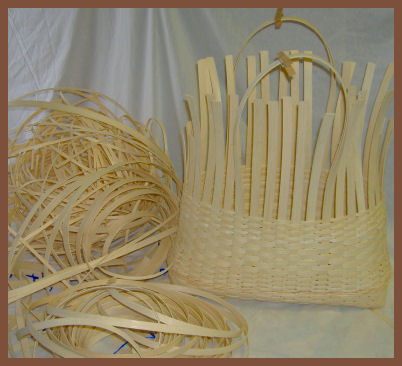
Many Cambodian farmers weave baskets (Khmer: tbanh kantrak) for household use or as a supplemental source of income. Most baskets are many of thinly cut bamboo. Regions known for basketry include Siem Reap and Kampong Cham. Mat weaving (tbanh kantuel) is a common seasonal occupation. They are most commonly made from reeds, either left a natural tan color or dyed in deep jewel tones. The region of Cambodia best-known for mat weaving is the Mekong floodplain, especially around Lvea Em district. Mats are commonly laid out for guests and are important building materials for homes. Wicker and rattan crafts (tbanh kanchoeu) made from dryandra trees are also significant. Common wicker and rattan products include walls, mats, furniture, and other household items.

Stone carving (Sculpture)


[Photo by Felix_KL on Flickr: Apsara dancers carved in stone at Angkor Wat temple, Siem Reap, Cambodia. 2006]

Cambodia's best-known stone carving adorns the temples of Angkor, which are "renowned for the scale, richness and detail of their sculpture". In modern times, however, the art of stone carving became rare, largely because older sculptures survived undamaged for centuries (eliminating the need for replacements) and because of the use of cement molds for modern temple architecture. By the 1970s and 1980s, the craft of stone carving was nearly lost.

During the late 20th century, however, efforts to restore Angkor resulted in a new demand for skilled stone carvers to replace missing or damaged pieces, and a new tradition of stone carving is arising to meet this need. Most modern carving is traditional-style, but some carvers are experimenting with contemporary designs. Interest is also renewing for using stone carving in modern wats. Modern carvings are typically made from Banteay Meanchey sandstone, though stone from Pursat and Kompong Thom is also used.

Lacquerware


[Photo by Wikipedia: A Cambodian woman works on a lacquered vase]

The height of Cambodian traditional lacquerware was between the 12th and 16th centuries; some examples of work from this era, including gilded Buddha images and betel boxes, have survived to the present day. Lacquerware was traditionally colored black using burnt wood, representing the underworld; red using mercury, representing the earth; and yellow using arsenic, representing the heavens. Lacquer on Angkorian stone dates to the 15th or 16 century.

In modern Cambodia, the art of lacquerwork nearly faded into oblivion: few lacquer trees survived, and lacquer was unavailable in local markets. Today's revival is still in its infancy, but 100 lacquer artists have been trained by a French expert under the guidance of Artisans d'Angkor, a company that produces traditional crafts in village workshops. Some artists are "beginning to experiment with different techniques and styles...to produce modern and striking effects."

Silversmithing


[Photo by Wikipedia: Lotus-shaped Cambodian bowl (gold and silver alloy)]

Silversmithing in Cambodia dates back centuries. The Royal Palace traditionally patronized silversmiths' workshops, and silversmiths remain concentrated at Kompong Luong, near the former royal capital Oudong. Silver was made into a variety of items, including weaponry, coins, ceremonial objects used in funerary and religious rituals, and betel boxes. During Cambodia's colonial period, artisans at the School of Fine Art produced celebrated silverwork, and by the late 1930s there were more than 600 silversmiths. Today, silverwork is popular for boxes, jewellery, and souvenir items; these are often adorned with fruit, fire, and Angkor-inspired motifs. Men produce most of the forms for such work, but women often complete the intricate filigree.

Ceramics


[Photo by kendrickhang on Flickr: Khmer Ceramics and Bronzes Revival Center, Siem Reap, Cambodia]

Cambodian pottery traditions date to 5000 BCE. Ceramics were mostly used for domestic purposes such as holding food and water. There is no evidence that Khmer ceramics were ever exported, though ceramics were imported from elsewhere in Asia beginning in the 10th century. Ceramics in the shape of birds, elephants, rabbits, and other animals were popular between the 11th and 13th centuries.

Potting traditionally was done either on a pottery wheel or using shaping tools such as paddles and anvils. Firing was done in clay kilns, which could reach temperatures of 1,000–1,200 °C, or in the open air, at temperatures of around 700 °C. Primarily green and brown glazes were used. In rural Cambodia, traditional pottery methods remained. Many pieces are hand-turned and fired on an open fire without glaze. The country's major center for pottery is Kompong Chhnang Province. In modern Cambodia, the art of glazed ceramics faded into oblivion: the technique of stoneware stop to be used around 14th century, at the end of Angkor era. Today this technique begin a slow revival through a Belgian ceramist who founded the Khmer Ceramics Revival Center, in Siem Reap, the organization lead vocational training and researches about this lost skill.

Wat murals (The murals in the temple)


[Photo by ultrapop design on Flickr: Wat mural]

Because of destruction during recent war, few historic wat murals remain in Cambodia. In the 1960s, art historians Guy and Jacqueline Nafilyan photographed 19th-century murals, providing a record of this lost cultural heritage. The best known surviving murals are at the Silver Pagoda in Phnom Penh, Wat Rajabo in Siem Reap province, and Wat Kompong Tralach Leu in Kompong Chhnang Province. In the last decade, wat murals have seen a resurgence, but Cambodia's surviving older murals are generally more refined and detailed.

Masks


[Photo by nuke_ad on Flickr: Khmer Traditional Mask]

Masks are usually used by the artists for performing in Lakhaon Khaol in the Royal Palace in performances of the Reamker as early as the 13th century. Masks also used by Chhayam performers (Sva:Monky, Yeak:Giant...) to make fun in their performing.

See More at: http://www.culturalprofiles.net/cambodia/Directories/Cambodia_Cultural_Profile/-1831.html

Kites


[Photo by Narith5 on Flickr: A boy with a kite]


[Photo by Narith5 on Flickr: A boy with a high flying kite]

Cambodia's kite-making and kite-flying tradition, which dates back many centuries, was revived in the early 1990s and is now extremely popular throughout the country. Kites (Khmer: khleng ek) are generally flown at night during the northeast monsoon season. A bow attached to the kites resonates in the wind, producing a musical sound. They usually see Khmer people (especially children) fly their kites after havesting.

b.Modern and contemporary visual arts


[Photo by TaylorMiles on Flickr: Khmer painting, Overpriced painting, Angkor Wat]

Cambodia's tradition of modern (representational) drawing, painting, and sculpture was established in the late 1940s at the School of Cambodian Arts (later called the University of Fine Arts), where it occupied occupied much of the school's curriculum a decade later. These developments were supported by the government, which encouraged new areas of specialization (e.g. design and modern painting) at the school and purchased modern art for the Prime Minister's residences and for government buildings. Galleries opened in Phnom Penh during the 1960s, and cultural centers hosted exhibitions of modern paintings and provided art libraries. During the subsequent Khmer Rouge era, many artists were killed and art production nearly ceased.

After the fall of the Khmer Rouge, artists and professors returned the University of Fine Arts to rebuild arts training. Socialist Bloc governments sponsored the education of young art students in Poland, Bulgaria, the former Soviet Union, and Hungary during the late 1980s and early 1990s. Other local efforts aimed to re-establish workshops, collect documents, and preserve traditional knowledge.

Though several galleries present changing exhibitions in Phnom Penh, the vast majority of artists cannot support themselves through exhibitions and sales of modern work. Artists generally earn income from Angkor-inspired art for tourists or from painting commercial signs and large reproductions that in the West would be mechanically produced.

Several broad schools of art exist among modern Cambodian artists. Some artists, including Som Samai (a silversmith), An Sok (a mask-maker), and Chet Chan (a painter) follow colonial traditions to produce traditional Khmer art. Chhim Sothy's work is also derived from these traditions. Many young artists who studied abroad in the 1980s, including Phy Chan Than, Soeung Vannara, Long Sophea, and Prom Sam An, have presented a modern Khmer art forms combining subjects from Khmer art with Western modernism. Other notable Cambodian artists include Leang Seckon, Pich Sopheap, Svay Ken, Asasax, Chhan Dina, Lam Soeung, and Chhorn Bun Son. During the 1990s, Cambodia saw the return of many members of the Khmer diaspora, including several internationally recognized artists. Among these are Marine Ky and Chath Piersath.

These Khmer arts make Cambodia to be known as a country rich of culture......

Read more...

If you like this post, please subscribe below,thanks!

Enter your email address:

Delivered by FeedBurner

To Get Update All Posts About Cambodia, Please Subscribe here,Thanks!

Wednesday, 20 May 2009

Khmer Art-Cambodian Art

[Photo by VIPNYC on Flickr: Apsara Dancers, Cambodia]

All the countries around the world always have their own cultures to distinguish from other countries in this world. Talking about art, Art is an important part of the culture of each country, that means through the activites of art, people in other countries can know what and where that country is. Meanwhile Cambodia is a country also known as a country rich of culture. How the Cambodia's art it is that makes the country to be known like that? Please take a look at the serveral points:

1. Khmer Dance-Cambodian Dance: The special features of Khmer Dance are based on its style of dancing, types of dance or its forms of dance. Each style has its own meaning, the way to dance is abit different from each other. In what way that it has the difference. Well, the point is that when and where the dance will be celebrated, Example: The Dance in Royal Palace has its own style, which type of dance should be chosen for dancing to pleasure the king. And it's also depended on the occasion which it will be chosen.

There are 3 main categories of Khmer dance-Cambodian dance:

a. Classical Dance: Khmer classical dance, also known as Khmer royal ballet or Khmer court dance, is a form of Cambodian dance originally performed only for royalty. It is called robam preah reachea trop in the Khmer language, which means 'dances of royal wealth.'

The ones among the well know royal ballet, Apsara Dance is a major dance which firstly performed on the re-creation by princess Norodom Bopha Devi, the first Daughter of King Norodom Sihanouk at 1964.

[Photo by Wikipedia Apsara Classical Dance of Princess Bopha Devi, Cambodia]

The following is the selected list of the Khmer Classical Dance:


-Apsara Dance: A dance about the apsara named Yaovamalya and her servants picking flowers for her in a garden.
-Tep Monorom: A dance about angels dancing in delight and Powering from the god to recuse the people.
-Robam Thvay Preah Por: A dance presented to the King of Cambodia.
-Robam Phuong Neari: A dance concerning the beauty of flowers and maidens.
-Robam Moni Mekhala: An excerpted dance about Manimekhala with Ream Eyso (Parashurama) in pursuit of taking away her crystal ball.
-Robam Sovann Maccha: An excerpted dance from the Reamker about Hanuman' and Suvannamaccha, the golden mermaid.

b. Folk Dance: Folk dances here refer to a performing art where it is performed for an audience.Khmer Folk dances show about Khmer daily life activities like fishing, harvesting..etc. Khmer folk dances are fast-paced. The movements and gestures are not as stylized as Khmer classical dance. Some folk dances are about love, or are folktales about animals. The kind of dance particularly performed depends on the area and its local birthplace. The most famous of all, Robam Trot, is mainly performed during the Cambodian New Year. The Dance got its history along a legend about a hunter and deer.

[Photo by Wikipedia Cambodian Daily Life Folk Dance, Robam NeiSart, Fishing Dance, Cambodia]


The following is the well known selected list of Khmer Folk Dance:

- Trot Dance: a popular dance represent a tales of a hunter and a deer who spread several danger between gaint to ogress and peacock.Trot Dance perform to chase away bad luck, just like Dragon dance during Chinese New Year.Its history know as came from Samrey People who is one of the most khmer enthic group and now live at Kulean Mountain area, Svay Leu District, Siem Reap. Another than Cambodia, Khmer Surin also likely act the dance out as well with a similar song which combined between Khmer Language and Thai Language.
- Pailin Peacock Dance: a dance which highly focus on Peacock style included Dress and Movement style.A enthic group in Cambodia, Kola people in Pailin which come from Burma, create this dance depend on burma costume.
- Yike Dance: The Dance is comfirm with opera combination with dance, perform along the legend of gaint and royalty.It originally was born in Java.
- Chhayam: A dance illustrates about enjoyable and a well know entertain dance included several active comedian and a beautiful girl dance.The dance performanced at a holiday and is a pure khmer dance. The Chhayam dance is usually performed during Kathen Festival, a kind of Khmer festival usually celebrated once a year at Pagoda from the middle of October to the middle of Novervember which lasts for a month.

[Photo by Ouddompheap2.blogspot.com , Robam Chhayam, Kathen Festival, Cambodia]


c. Vernacular Dance or social dance

In Cambodia, vernacular dance (or social dance) are dances which are danced at social gatherings. Such dances include Ram Vong, Ram Kbach, Ram Saravan, Lam Leav (literally: "Lao dance") and so on. Some of these dances have much influence from the traditional dances of Laos. But Ram Kbach, for example, take heavily from the classical dance of the royal court. Rom Kbach is a simple dances which uses hand gesture similar to that of classical dance and Rom Kbach song also utilize the melodies of classical dance songs and combine them with traditional Khmer and Western instruments.
Other social dances from around the world have had an impact on Cambodian social culture include the Cha-cha, Bolero, and the Madison. Such dances are often performed at Cambodian wedding receptions and banquets.

2. Khmer Music-Cambodian Music: Can we dance without music? Yes we can, but this kind of dance would be no style, no form, no rhythm, or no cadence. Dancing always goes with music. How the rhythm of music is, the style of dance would follow the rhythm of the music. The Khmer Dance and Khmer Music are also the same.

Khmer Music can be devided into two categories:

a. Folk and classical music

Cambodian folk music is highly influenced by ancient forms as well as Hindu forms. Religious dancing, many of which depict stories and ancient myths, are common. Some dances are accompanied by a pinpeat orchestra, which includes a ching (cymbal), roneat (bamboo xylophone), pia au (flute), sralai (oboe), chapey (bass banjo), gong (bronze gong), tro (fiddle), and various kinds of drums. Each movement the dancer makes refers to a specific idea, including abstract concepts like today (pointing a finger upwards). The 1950s saw a revival in classical dance, led by queen sisowath Kosmak Monyrat. To find out more about Traditional Cambodian musical instruments, please visit here!

b. Popular music

Cambodian pop music, or Cambodian modern music is usually presented in Cambodian Karaoke VCDs with the most popular rhythm Ram Vong, Ram Kbach, Saravann, Lam Leav, and usually of an actor, actress or both making the actions, usually by mimicking the lyrics to the background song by moving their mouth as if they were actually singing the song. Noy Vannet and Lour Sarith are some of the modern singers who sing the songs for use with the Karaokes usually of the songs composed by Sin Sisamouth or others, in addition to the songs sung and composed by Sin Sisamouth himself.

Please enjoy watching Cambodian Karaoke from Youtube Video below and how do you thing about Cambodian popular music:

- The first Video is a kind of Music Ram Vong, including two songs, the first song has the title "Mei Mai Kon Muoy" in English "Widow with one child" with the short meaning "Cool rice is rice, Widow is woman...Widow with one child is hot...". The song is sung and performed by Sopheap and Marima. And the second song with the title"Som Kann Day Mun Reab Kar" in English "Please Let me hold your hand before marriage" sung and performed by Sopheap and Soksoaphea. Please enjoy dancing! To know how to dance Ram Vong style, please visite here !


- The second video is a KARAOKE song with Ram Kbach style:


To be continued more...please come back soon,thanks!

Read more...

If you like this post, please subscribe below,thanks!

Enter your email address:

Delivered by FeedBurner

To Get Update All Posts About Cambodia, Please Subscribe here,Thanks!